Digital Marketing for Small Businesses: How to Reach More Customers

Running a small business is difficult enough without having to compete for attention across search engines, social media, advertising platforms, and countless other businesses online. Your customers are already spending time online. They search Google for services, compare businesses, read reviews, browse social media, watch videos, and look at websites before deciding who to contact. If your business is not visible during these moments, potential customers may choose a competitor instead.
This is where digital marketing for small businesses becomes important. Digital marketing gives businesses different ways to reach potential customers, build awareness, generate leads, and turn online visitors into paying customers. It can include search engine optimization, Google Ads, social media marketing, content marketing, email marketing, and conversion optimization.
The goal is not to use every available platform simply because it exists. The goal is to identify where your customers spend their time, understand what they are looking for, and create a marketing strategy that helps your business reach them at the right stage of their decision-making process.
Digital marketing is the use of online channels and digital technologies to promote a business, communicate with customers, generate interest, and drive conversions. Unlike traditional marketing, digital marketing allows businesses to measure many aspects of their campaigns. You can often see:
This data gives businesses an opportunity to make better decisions.
For example, if a company spends money on several marketing channels and discovers that one campaign consistently generates qualified leads while another produces traffic but no conversions, the company can adjust its strategy. That ability to measure, test, and improve is one of the major advantages of digital marketing for small businesses.

Having a website or social media account does not automatically create customers. A business can have:
and still struggle to generate leads. The problem is usually not a lack of digital assets. The problem is a lack of strategy. A digital marketing strategy connects different marketing activities to specific business goals. For example, if the goal is to generate more qualified leads, the strategy might use SEO to attract relevant traffic, content to educate potential customers, landing pages to guide visitors, and conversion-focused elements to turn those visitors into leads.
Another business may need faster results and use Google Ads to send targeted traffic to a landing page that encourages a sales call or inquiry. A business focused on brand awareness may rely more on social media, content, engagement, and website visits. The channels can differ, but the principle remains the same: every marketing activity should have a clear purpose and support a measurable business objective.
One of the biggest mistakes businesses make is starting with the marketing channel instead of the customer. They ask whether they should use Instagram, run Google Ads, or start a blog before understanding who they are trying to reach and what that audience actually needs.
Start with:
Who are we trying to reach?
Then determine:
Once you understand those things, you can determine which marketing channels make sense.
Search engine optimization is one of the most important parts of a long-term digital marketing strategy. SEO helps businesses improve their visibility in organic search results. Imagine someone needs a service.
They search Google for: “SEO agency near me” or: “home care agency in Denver” or: “personal injury lawyer in Newark” The businesses that appear prominently have an opportunity to attract that customer. SEO involves many different activities, including:
The goal is not simply to rank for as many keywords as possible. The goal is to appear for searches that are relevant to your business and have the potential to generate valuable customers.
SEO is valuable, but it takes time. Businesses that need faster visibility can use Google Ads. Google Ads allows businesses to advertise to people searching for relevant products and services.
For example, a contractor might target searches such as:
A law firm might target:
The advantage is that businesses can reach people who are already showing interest in a particular service. However, running Google Ads does not automatically guarantee good results.
Campaigns need:
A campaign can generate hundreds of clicks and still fail if those clicks do not turn into qualified leads.
Not every customer starts their journey with Google. Some discover businesses through social media. Platforms such as Facebook and Instagram allow businesses to:
For visually driven businesses, social media can be particularly useful.
This includes:
But social media should not simply become a place where businesses post promotional messages every day.People generally do not follow businesses because they want to see advertisements constantly. Useful content can include:
The goal is to create a reason for people to pay attention.
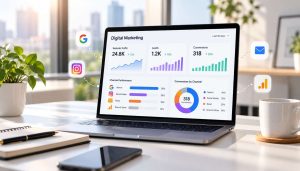
Organic social media and paid social advertising serve different purposes. Organic social media focuses on building an audience and maintaining engagement. Paid advertising allows businesses to reach specific audiences through targeted campaigns. For example, a business could create campaigns based on:
Retargeting can also help businesses reconnect with people who previously interacted with their website or content. Someone may visit a website without making a purchase. A retargeting campaign can potentially bring that person back when they are more ready to take action.
Content marketing involves creating useful material that helps attract, educate, and engage your audience. Content can include:
Good content answers questions. Suppose you are a home care agency. Instead of publishing endless posts about your company, you could create useful articles about:
People searching for this information may eventually need professional services. Your content introduces your business before the customer is ready to buy.
Not every topic deserves an article. Your content should connect to your business. Suppose a digital marketing agency offers:
Its blog could cover:
Each article can connect naturally to an appropriate service. For example:Article: How Local SEO Helps Businesses Get Found Related service: Local SEO. This creates a relationship between educational content and commercial pages.
A website should not be treated as a separate project from marketing. Your website is where many marketing activities ultimately lead. Someone may discover your business through:
They may then visit your website. What happens next matters. If the website is slow, confusing, hard to navigate, or unclear about what the business offers, the marketing campaign may lose value. A marketing-focused website should:
Marketing brings people to the website. The website helps turn those visitors into opportunities.
Sending every advertisement to the homepage is not always the best approach. A dedicated landing page can focus on one specific service or campaign, such as sending a Google Ads campaign to a Google Ads Management page, an SEO campaign to an SEO Services page, or a home care campaign to a Home Care Services page.
A focused landing page can match the customer’s search intent more closely by clearly explaining the specific service, its benefits, the process, trust signals, testimonials, frequently asked questions, and the next step. The more closely the page matches what the visitor expected to find, the easier it becomes for them to understand the offer and take action.
Getting visitors is only half the job. You also need to give them a reason to take action. Conversion optimization focuses on improving the percentage of visitors who complete a desired action. That action might be:
Small changes can sometimes make a meaningful difference. For example: Instead of: Submit You might use: Request Your Free Consultation Instead of hiding contact information in the footer, you might place a phone number prominently in the header.
Instead of using a generic headline, you might explain exactly what the business helps customers achieve. These changes can make the customer journey clearer.
Not every visitor is ready to buy immediately. Someone might visit your website today but not contact you until several weeks later. Email marketing can help businesses maintain communication with interested audiences. Email campaigns can include:
For example, someone downloads a guide from your website. Instead of losing contact with that person, you can provide additional useful information through an email sequence. Over time, that relationship can lead to a purchase or consultation.

Customers rarely follow a perfectly straight path. A person might:
This is why businesses should think about the entire customer journey rather than focusing on one isolated channel. Different marketing channels can support different stages.
Awareness: Social media and content can introduce people to your business.
Consideration: SEO, blog content, reviews, and service pages can help them evaluate your company.
Conversion: Google Ads, landing pages, strong CTAs, and consultation forms can encourage action.
Retention: Email marketing and ongoing communication can help maintain customer relationships.
One of the biggest advantages of digital marketing is the amount of information businesses can collect. Website traffic, search queries, ad clicks, conversion rates, lead sources, social engagement, email performance, and landing page results can all provide useful insight into how well a strategy is working. This allows businesses to make decisions based on evidence rather than assumptions.
For example, a website may receive 1,000 visitors but generate only 5 leads, which could indicate problems with targeting, messaging, landing pages, navigation, calls to action, or trust. Another campaign might bring only 300 visitors but generate 25 qualified leads, making it far more valuable. This is why the goal should not simply be to attract more traffic, but to attract better traffic and convert more of those visitors into real business opportunities.
Businesses often focus on metrics that look impressive but do not necessarily create revenue. For example:
These can be useful indicators, but they are not always the most important measurements. Depending on the business, more meaningful metrics may include:
A good marketing strategy connects activity to business outcomes.
Digital marketing rarely works because of one advertisement or one blog post. It usually requires consistency.
A business may need to:
Over time, these activities build momentum. For example, a business that publishes one useful article every few months may have limited results. A business that consistently creates useful content around its services, optimizes its website, and promotes that content has more opportunities to build visibility. The same principle applies to social media, paid advertising, email marketing, and SEO.
One common marketing mistake is trying to use every platform simultaneously. A small business might create accounts on:
Then struggle to maintain any of them properly. Being everywhere is not necessarily a strategy. It is usually better to identify where your customers actually spend time and focus your resources there. For a B2B company, LinkedIn may be more valuable than TikTok. For a restaurant, Instagram and Google may be more important. For a local service business, Google Search and local SEO may produce more valuable leads than several social platforms combined. Your strategy should follow your audience.
There is no universal marketing budget that works for every company.
The right budget depends on:
A business should understand its economics before setting a budget. For example, if acquiring a customer costs $100 but that customer generates $1,000 in revenue, the marketing investment may make sense. If acquiring the customer costs $500 and the customer only generates $200, the strategy needs to change. This is why businesses should focus on return and profitability, not simply spending more.
Marketing and web development should not operate in separate worlds. A website should support marketing objectives from the beginning. For example, a website can be designed around:
This creates a stronger relationship between the technical and marketing sides of a business. A beautifully designed website that produces no leads is not enough. A marketing campaign sending traffic to a poor website is also inefficient. The strongest results come when the two work together.
There is no point where a business can realistically say its digital marketing is completely finished. Markets, customer behavior, competitors, search trends, advertising costs, and digital platforms continue to change, which means a strategy that worked two years ago may not deliver the same results today.
Successful businesses regularly review their marketing performance and make adjustments when needed. This does not mean changing direction every week. It means using real data and evidence to identify what is working, what needs improvement, and where resources should be focused for better results.
Digital marketing for small businesses is not about being active on every platform or spending as much money as possible. It is about creating a clear path between your business and the customers you want to reach. SEO can help people discover your business through search, Google Ads can provide targeted visibility when customers are actively looking for services, social media can build awareness and engagement, content marketing can answer questions and establish expertise, and email marketing can help maintain customer relationships.
Your website should bring these activities together and turn interested visitors into leads and customers. The most effective approach is to build a strategy where each channel supports the others rather than treating them as separate marketing tasks. The goal is simple: get found, build trust, generate interest, convert visitors, and keep improving. That is what turns digital marketing from a collection of online activities into a system that can support real business growth.


276 5th Ave 7th Floor, Suite 704B, New York, NY 10001