Google Ads vs. SEO: Which Strategy Is Right for Your Business?

When people need a product or service, many of them turn to Google before making a decision. They may search for a local business, compare providers, read reviews, visit websites, or look for specific services. For businesses, this creates an important opportunity to reach potential customers at the moment they are actively looking.
Two of the most common ways to appear in Google search results are Google Ads and SEO. Google Ads can put your business in front of potential customers through paid search placements, while SEO focuses on improving your organic visibility over time. Both can generate valuable traffic and leads, but they work differently and serve different purposes.
So which one is better? The honest answer is that there is no universal winner. The right approach depends on your business, goals, competition, budget, timeline, and customers. In many cases, the strongest strategy is not choosing between Google Ads vs SEO, but using both strategically.
Search engine optimization, commonly known as SEO, is the process of improving a website and its online presence so that it has a better opportunity to appear in organic search results. Unlike paid advertising, organic search results are not purchased on a per-click basis. SEO involves many different activities, including:
The objective is to make your website more useful to visitors and easier for search engines to understand. For example, imagine a business that provides home care services in Denver. Potential customers might search for: “home care agency in Denver” or: “24 hour home care near me” A well-optimized website can potentially appear in those organic results when Google determines that the page is relevant and useful for the search. SEO is generally a long-term strategy. You build visibility over time rather than paying for every individual visit.
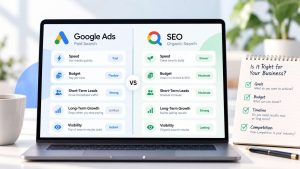
Google Ads is Google’s paid advertising platform that allows businesses to show ads across Google Search and other placements within Google’s advertising network. For example, a digital marketing agency might target searches such as “digital marketing agency NYC” or “Google Ads agency near me,” allowing eligible ads to appear in sponsored search results.
Businesses usually pay based on the campaign type and bidding model, often when someone clicks an ad in a search campaign. Google Ads can help businesses reach potential customers without waiting for organic rankings to develop, making it useful for generating traffic, leads, and inquiries more quickly.
The simplest way to understand the difference is that Google Ads provides paid visibility, while SEO focuses on organic visibility. With Google Ads, businesses pay to participate in advertising auctions and appear in front of people searching for targeted terms. With SEO, businesses improve their website, content, and overall online presence to increase their chances of ranking organically in search results.
Both Google Ads and SEO can generate website traffic and leads, but they work differently and require different strategies. Google Ads can provide faster visibility while the campaign is active, whereas SEO typically focuses on building sustainable organic visibility over time.
This is one of the biggest differences between Google Ads and SEO.
Google Ads can begin generating traffic shortly after campaigns are approved and running. That makes it useful for businesses that:
However, immediate traffic does not automatically mean profitable campaigns.
You still need:
A poorly managed Google Ads campaign can spend money without producing enough valuable leads.
SEO generally takes longer. A new website usually cannot expect to rank for competitive searches immediately. Search visibility can depend on:
SEO requires consistent work. You may need to improve technical issues, create content, optimize important pages, build authority, and strengthen your local presence. The advantage is that successful organic rankings can continue generating traffic without paying for every individual click.
This depends heavily on the business and strategy. With Google Ads, the cost is directly connected to advertising activity. You establish an advertising budget and pay according to how your campaigns operate.
For example, a business might allocate a specific monthly budget to Google Search Ads. That money can produce traffic quickly, but once the campaign stops, the paid traffic generally stops as well. SEO works differently.
You are investing in:
SEO may require a significant investment before producing substantial results. But the value of organic visibility can continue after the initial optimization work has been completed. This does not mean SEO is “free.” It is better to think of SEO as an investment in long-term visibility.
One major advantage of Google Ads is control. You can control many aspects of a campaign, including:
For example, a business that only serves customers in New York does not necessarily need to show advertisements across the entire country. Campaign targeting can be adjusted to focus on relevant locations. Similarly, a business can increase or decrease its budget based on performance. This level of control can be particularly valuable when testing a new service or market.
SEO generally provides less immediate control over rankings. You cannot simply decide that your website should rank number one tomorrow. Search engines determine organic rankings based on many signals and systems. However, SEO can create a valuable long-term asset.
Suppose a business spends months improving a service page and eventually earns a strong organic ranking for an important search. That page may continue attracting visitors over time. The business does not pay Google for every organic click. That is one reason companies invest in SEO even when they are already running paid advertising campaigns.
For many local businesses, using both Google Ads and SEO can be effective. This approach can work well for businesses such as law firms, dental practices, home care agencies, HVAC companies, plumbing companies, marketing agencies, and contractors that depend on local customers searching for specific services.
A potential customer may search for terms such as “plumber near me,” “personal injury lawyer in Newark,” or “home care agency in Denver.” Google Ads can provide immediate visibility for these searches, while local SEO can help the business build organic visibility and appear in local search results over time. Together, these strategies create multiple opportunities to reach the same potential customer.
A new business often faces a difficult problem. It needs customers to build revenue, but it does not yet have a strong online presence. SEO takes time. A new website may have little authority and few backlinks. Google Ads can provide a faster way to get the business in front of potential customers.
For example, a new home services company could launch targeted Google Search campaigns while simultaneously building its organic presence. The paid campaign can generate immediate traffic while the SEO strategy works toward longer-term visibility. This can be a practical combination.
An established business may already have:
For that company, SEO can help strengthen its existing digital presence. The business can identify:
Then it can improve those areas over time. SEO can also reduce dependence on a single marketing channel. A business that relies entirely on paid advertising may face problems if advertising costs increase or campaigns become less profitable. Organic visibility provides another source of potential traffic.
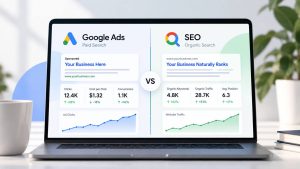
Competition plays an important role in both SEO and Google Ads. Some industries have much more competitive keywords than others. For example, a term such as “personal injury lawyer” may be significantly more competitive than a search like “commercial cleaning company in a small local market.” The same applies to paid advertising, where highly competitive keywords can have expensive clicks because many businesses are trying to reach the same customers.
Before choosing a strategy, businesses should research competitors, search volume, keyword intent, advertising competition, organic competition, and the potential value of each customer. A keyword may look attractive because it has strong search demand, but it may not be profitable if the cost of acquiring a customer is too high compared with the revenue that customer is likely to generate.
One of the biggest mistakes businesses make is focusing only on how many searches a keyword receives. Traffic is useful, but intent matters more. Consider these two searches: “What is SEO?” and: “SEO agency near me” The first person may simply be learning. The second person may be actively looking for a provider. Both searches have value, but the second has stronger commercial intent. This applies to both SEO and Google Ads. A successful marketing strategy targets searches that align with the business’s goals.
One useful benefit of Google Ads is that businesses can gather performance data relatively quickly. Suppose you are unsure whether customers respond better to: “SEO company” or: “SEO agency” A paid campaign can help you test different keywords and messaging.
You may discover:
Those insights can inform other marketing activities. For example, successful paid keywords may deserve more attention in your SEO strategy.
The relationship between SEO and paid search does not have to be one-sided. Data from SEO can also improve Google Ads. For example, organic search data may reveal:
Those insights can help inform paid campaigns. Likewise, Google Ads can reveal which keywords and messages generate valuable conversions. This creates an opportunity for the two channels to support one another.
Whether someone reaches your website through Google Ads or organic search, the landing page matters. A visitor should quickly understand:
A landing page with confusing messaging can waste traffic from both channels. Important elements can include:
For paid campaigns, landing page relevance can also influence campaign performance. For SEO, a useful and well-structured page can improve the experience for visitors who arrive through organic search.
Neither SEO nor Google Ads should be judged solely by traffic. Businesses need to know what happens after someone visits the website. Depending on the business, important conversions could include:
Imagine a Google Ads campaign generates 500 clicks. That sounds impressive. But what if none of those visitors become customers? The campaign may not be performing well. Now imagine another campaign generates only 150 clicks but produces 20 qualified leads. The second campaign may be far more valuable. This is why conversion tracking is an essential part of digital marketing.
The right combination can also benefit online stores. Google Ads can help promote:
SEO can help the store build organic visibility around:
For example, an online furniture company could use paid campaigns to promote specific products while creating organic content around topics such as:
This allows paid and organic strategies to support different stages of the buying journey.
Google Ads may be a strong option when: You Need Results Quickly Paid search can generate traffic much faster than waiting for new organic rankings. You Are Launching a New Service You can test whether there is demand before investing heavily in long-term content.
You Have Strong Customer Value If one new customer is worth a significant amount of revenue, paid acquisition may make financial sense. You Want Precise Targeting You can target specific locations, keywords, audiences, schedules, and campaigns. You Have a Defined Budget You can establish and manage an advertising budget.
SEO may be a stronger priority when a business wants to build long-term visibility and attract consistent organic traffic over time. It can be especially valuable when potential customers regularly search for the services the business provides, creating ongoing opportunities to appear in relevant search results.
SEO can also help reduce dependence on paid traffic by creating an additional customer acquisition channel. Businesses with valuable expertise can use that knowledge to create useful content, answer common customer questions, and build authority. For companies focused on long-term brand growth, consistent organic visibility can also support stronger brand awareness and credibility.
For many businesses, the best answer to Google Ads vs. SEO is to use both. A combined strategy can provide short-term and long-term benefits by helping a business generate visibility now while also building a stronger organic presence for the future.
In the short term, Google Ads can help generate immediate traffic, test keywords, attract leads, and promote important services. Over the long term, SEO can improve organic visibility, strengthen service pages, build useful content, support local rankings, and increase website authority. By tracking performance across both channels, a business can gradually allocate more resources toward the strategies producing the strongest results.
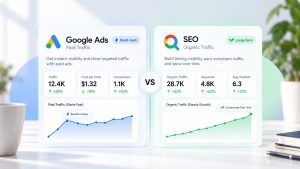
Imagine a local digital marketing agency in New York. The agency wants to generate more leads.
The agency could create campaigns around searches such as:
These campaigns could send visitors to dedicated service landing pages. The agency can track:
At the same time, the agency could optimize:
It could also publish useful content around:
Over time, the agency could build organic visibility while continuing to use paid advertising. This is a more complete approach than relying entirely on one channel.
Before choosing between Google Ads and SEO, ask several questions.
Do you need:
Your goal influences the strategy.
Highly competitive markets may require a stronger combination of paid and organic strategies.
Paid advertising requires an ongoing advertising budget. SEO requires investment in strategy, content, optimization, and ongoing work.
If one customer generates substantial revenue, paying more to acquire a qualified lead may still be profitable.
If you need leads immediately, Google Ads may be useful. If you are building for the next several years, SEO deserves serious attention.
Businesses sometimes make the mistake of treating paid advertising and SEO as completely unrelated. They are different channels, but they are both part of the same customer journey. Someone might:
Customers do not always follow a single predictable path. That is why your website, SEO, advertising, content, and conversion strategy should work together.
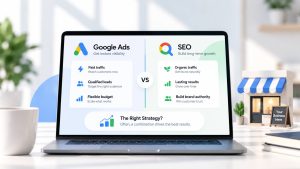
Neither SEO nor Google Ads can fully compensate for a poor website. If visitors arrive and find:
you may lose potential customers. Your website should support your marketing efforts. It should provide a clear path from: Search → Website → Trust → Action This is where web development and digital marketing overlap. A technically strong website provides the foundation, while SEO and advertising help bring the right audience to it.
The debate over Google Ads vs. SEO often assumes that businesses must choose one. That’s not necessarily true. Google Ads and SEO solve different problems.
Google Ads can provide:
SEO can provide:
The best choice depends on the business. For some companies, Google Ads may be the immediate priority. For others, SEO may be the better long-term investment. For many businesses, combining the two provides the strongest overall strategy.
The right answer to Google Ads vs. SEO is not simply one or the other. If your business needs immediate visibility and qualified traffic, Google Ads can provide a powerful way to reach people actively searching for your products or services. If you want to build long-term search visibility and reduce dependence on paid traffic, SEO can create a valuable foundation for sustainable growth.
The strongest strategy often combines both. Use Google Ads to capture opportunities today while investing in SEO to build visibility for tomorrow. Most importantly, measure both channels based on business results, not vanity metrics. Traffic, clicks, and rankings matter, but qualified leads, sales, appointments, and revenue are what ultimately determine whether your marketing is working. Your goal is not simply to appear on Google. Your goal is to be visible when the right customer is ready to choose your business.


276 5th Ave 7th Floor, Suite 704B, New York, NY 10001